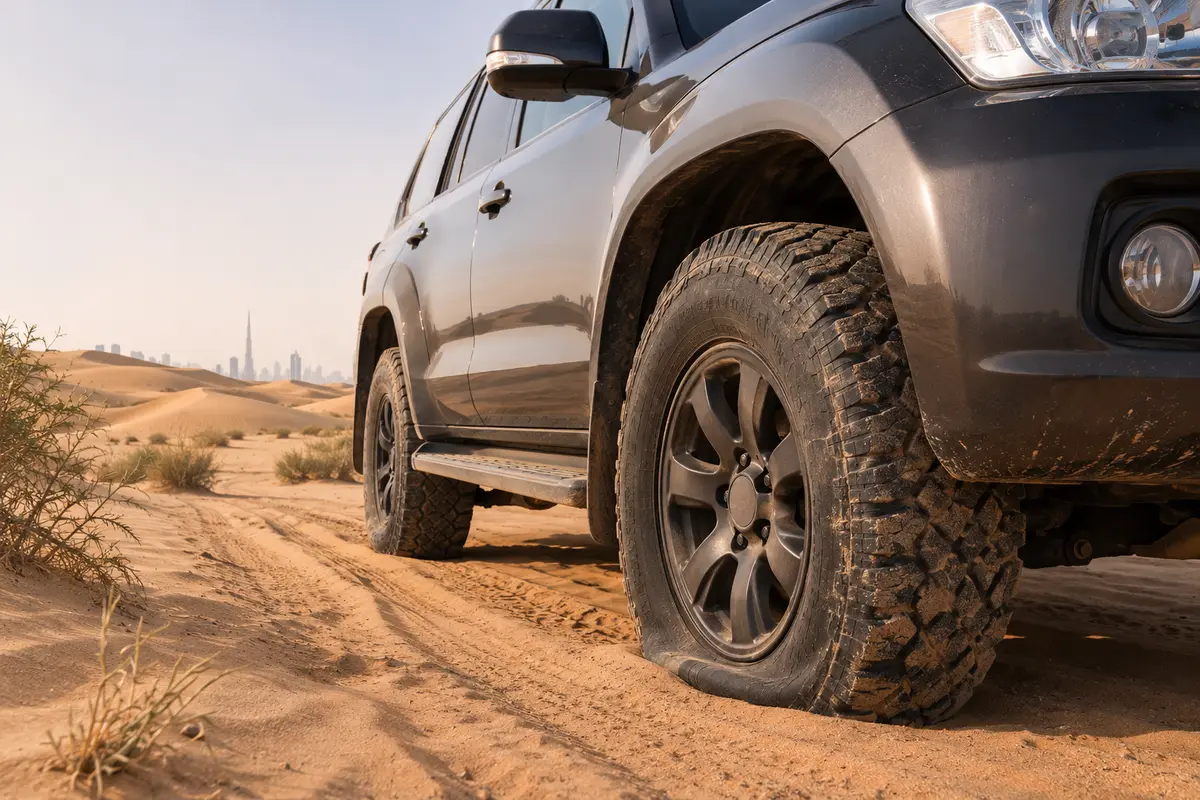
We see MT tyres mostly on modified Wranglers, Land Cruiser 70 Series and built-up pickups. They are tough and capable, but they come with real compromises for daily driving.
How mud-terrain tyres are built
MT tyres use very large tread blocks separated by wide voids, so the tread can clean itself and claw into loose surfaces. Sidewalls are usually three-ply LT construction with sidewall lugs that grip rock edges and protect against cuts. The compound is formulated for chip and tear resistance rather than highway wear, and the tyre is noticeably heavier than an AT of the same size.
Pros
- Highest resistance to cuts and punctures on rock
- Sidewall lugs give grip when aired down on rocky ledges
- Self-cleaning tread for wet wadis and mud after rain
- Very strong LT casing for heavy, modified vehicles
Cons
- Loud on the highway, with a hum you hear at 100 km/h and above
- Shorter tread life on tarmac, especially in summer
- Longer braking distances and reduced wet grip on road
- Heavy, which hurts fuel economy and acceleration
- In soft sand, the open tread can dig rather than float
Who should choose mud-terrain tyres
Best for
- Rock and wadi driving in Hatta, RAK and Fujairah
- Modified off-road builds
- Vehicles that spend a large share of their time off tarmac
Not ideal for
- Daily commuting on Sheikh Zayed Road
- Pure dune driving, where an AT floats better
- Owners sensitive to cabin noise or fuel cost
Mud-Terrain Tyres in UAE conditions
Most UAE off-roading is in sand, and that is where MT tyres are less clearly better than an AT. The aggressive lugs can dig in on soft dunes unless pressures are low and throttle is smooth. Their real strength here is in the stony wadis and mountain tracks, where an AT's sidewall can be cut. On the highway, an MT tyre at 140 km/h on E11 in August runs hot and wears fast, so keep speeds sensible and pressures correct.
Mud-terrain vs all-terrain
| Mud-terrain | All-terrain | |
|---|---|---|
| Rock and wadi toughness | Excellent | Good |
| Soft dune flotation | Good if aired down carefully | Very good |
| Highway noise | High | Moderate |
| Tread life on tarmac | Shorter | Longer |
| Starting price | From AED 550 | From AED 450 |
If you split your time between the city and the dunes, an all-terrain tyre is usually the better buy. MT makes sense when your vehicle is built for rough trails and you accept the trade-offs on road.
The mud-terrains I replace early are not worn out from rocks. They are worn out from 20,000 km of daily commuting in summer. If the car mostly lives on the highway, an MT is the wrong tyre.
Living with MT tyres day to day
- Rotate every 8,000 to 10,000 km. Big blocks wear in a heel-and-toe pattern that gets noisier if ignored.
- Balance carefully. Large, heavy tyres often need more weight and a road-force check to feel smooth at 120 km/h. Book wheel balancing after fitting.
- Check the load index on the sidewall matches your build, especially with roof tents, bumpers and winches.
- Expect fuel consumption to rise compared with HT or AT tyres.
Rules and oversized tyres
Larger tyres than the vehicle was registered with can affect speedometer accuracy and registration inspections. Requirements vary between emirates, so check the current RTA or relevant authority rules before upsizing. Our UAE tyre regulations guide covers what is widely reported.
Popular mud-terrain tyres in Dubai
| Brand | Range |
|---|---|
| BFGoodrich | Mud-Terrain T/A KM3 |
| Toyo Tires | Open Country M/T |
| Nitto | Trail Grappler M/T |
| Maxxis | Bighorn MT-764 |
| Cooper | Discoverer STT Pro |
Typical vehicles: Jeep Wrangler, Toyota Land Cruiser 70 Series, Ford Bronco, Toyota FJ Cruiser, Nissan Patrol Y61, Ford F-150.